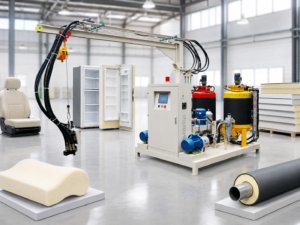
Quick answer. A manual or benchtop PU casting machine is the right choice when monthly resin throughput stays under roughly 3-5 tons, shot sizes run 0.5-20 kg, and mold changeovers happen weekly rather than daily. Once a single part clears about 10-20 tons of resin a month, a metered production line with closed-loop dosing and multi-station tooling pays back through lower reject rates and higher output per labor-hour. Buying the wrong tier either starves growth or ties up capital in idle capacity.
Small and mid-size manufacturers ask this question constantly, usually right after a benchtop unit runs out of hours or a production line sits half-loaded. The decision comes down to three numbers: monthly volume, the mix-ratio tolerance the part design demands, and how often the mold changes.
Prototyping vs. Volume Production: Two Different Jobs
Casting equipment for polyurethane rollers, wheels, gaskets, potting compounds and elastomer parts splits into two categories that solve different problems. A benchtop system exists to validate a formulation and a mold before committing capital. A production line exists to repeat that validated process thousands of times with minimal operator variance.
Confusing the two is the most common buying mistake we see. Teams size a production line off projected volume that never arrives, or run a benchtop unit past 8-10 hours a day trying to fill an OEM contract it was never built for.
Manual & Benchtop Casting Machines: What They Deliver
Metering, Mix Ratio and Shot Size
Benchtop low-pressure casting machines meter the polyol (A) and isocyanate (B) components with gear pumps at roughly ±1-2% volumetric accuracy. Tank capacity typically runs 20-200 L per side, with a heated, agitated jacket to hold viscosity stable through a shift.
Shot size per cycle usually falls between 0.5 kg and 20 kg, with pour rate around 2-8 kg/min. That is tight enough for most flexible and rigid systems tested against ASTM D1622 apparent density limits, but not tight enough for parts with a mix-ratio tolerance under 1%.
Where Manual Machines Earn Their Keep
Mold changeover on a single manual clamp station takes 10-30 minutes, so a benchtop machine can run five or six different molds in a day. That flexibility is exactly what R&D validation, engineering samples, replacement-part runs and MOQ testing before a program scales all need.
One trained operator can run the whole cell. Below roughly 500 pieces a month or 3-5 tons of resin, the labor and floor-space cost of a full line rarely pencils out against a benchtop unit.
Automated Production Lines: Where the Economics Flip
Throughput and Station Count
A production line replaces the gear pump with closed-loop, load-cell metering holding roughly ±0.5-1% mix-ratio accuracy – the tolerance most demanding elastomer and structural foam specs require. Continuous mixhead output runs 20-150+ kg/min depending on component size, feeding a carousel or conveyor with anywhere from 4 to 20+ mold stations.
Cycle time per station typically runs 2-8 minutes depending on part mass and system reactivity, with an integrated curing tunnel replacing the manual demold-and-cure step. That is how a line turns a formulation validated on a benchtop unit into thousands of consistent parts per shift.
Capex and Payback Threshold
A full line – metering skid, mix head, mold carousel, curing tunnel – represents an investment tier several times a benchtop machine’s cost and typically needs 50-150+ m² of floor space. That capital clears at volume: most SME buyers see payback once a dedicated part run holds above 10-20 tons of resin a month, or a single high-volume SKU runs continuously rather than in short batches.
Below that line, the extra metering precision and station count sit idle, and idle capex is the single biggest reason automated lines get mothballed within 18 months of a rushed purchase.
Side-by-Side: Machine Selection at a Glance
The table below lines up the dimensions that actually drive the decision, not just headline output.
| Dimension | Manual / Benchtop Machine | Automated Production Line |
|---|---|---|
| Capex tier | Entry-level; roughly 5-15% of a full line | 5-15x a benchtop unit |
| Mix ratio accuracy | ±1-2% (volumetric gear pump) | ±0.5-1% (closed-loop, load-cell) |
| Shot size / output | 0.5-20 kg per cycle, 2-8 kg/min | 20-150+ kg/min continuous |
| Mold stations | 1 (manual clamp) | 4-20+ (carousel/conveyor) |
| Mold changeover | 10-30 minutes | Fixed tooling; changed by shift, not by cycle |
| Operator skill needed | 1 trained, isocyanate-certified operator | 2-4 operators plus a metering/QC technician |
| Ideal monthly resin volume | Under ~3-5 tons | Above ~10-20 tons sustained |
| Best-fit use case | R&D samples, validation runs, spares, MOQ testing | Dedicated OEM / high-volume part run |
Compliance, Safety and the Decision Framework for SME Buyers
Regulatory Baseline You Can’t Skip
Isocyanate exposure rules apply to a one-operator benchtop cell the same as a ten-person line. OSHA’s isocyanates guidance sets workplace exposure limits and ventilation expectations that shape cell layout regardless of machine size.
In the EU, REACH restricts industrial and professional use of diisocyanates above 0.1% concentration unless the operator holds documented safety training – a requirement that applies per operator, not per machine, so a benchtop cell with one untrained hire carries the same compliance exposure as a full line.
When you evaluate a supplier, ask what quality management system governs their build process. A documented system aligned with ISO 9001 tells you the manufacturer controls process consistency – it does not replace asking for the specific machine’s own metering-accuracy test report and material certificates.
A Volume-Based Decision Framework
Three questions settle most of these purchases. First, what is your realistic monthly resin volume over the next 12 months, not the optimistic year-three number? Second, how many distinct molds run through the cell in a typical week? Third, what mix-ratio tolerance does the part spec actually require?
Under 3-5 tons a month with more than one mold change a week, buy the benchtop machine. Above 10-20 tons on one or two dedicated parts, size the line. Between those numbers, many shops run both – a benchtop cell for R&D and spares alongside a line for the volume SKU, rather than forcing one machine to do both jobs.
Why SME Buyers Source Casting Equipment Direct From the Factory
Going through a trading company typically adds a markup layer on top of the machine price and strips out engineering input on shot size, mixhead configuration or voltage (110V/220V/380V) before the order is placed. Buying direct from the manufacturer keeps that customization conversation open through the quote stage.
It also shortens the support chain when a metering pump or load cell needs a spare part two years in. A factory that built the unit can usually identify the failure from photos and ship the exact part, instead of routing the request through an agent who never saw the original build sheet. Our PU casting machine range covers both benchtop and production-line configurations built to the shot size and mold interface a buyer specifies at order time.
FAQ
Q: What mix-ratio accuracy do I actually need for PU casting?
It depends on the part spec, not the machine brochure. Flexible elastomer parts with a wide property window tolerate the ±1-2% a benchtop gear pump delivers; structural or load-bearing parts with a tight ILD or tensile spec usually need the ±0.5-1% a closed-loop production line provides.
Q: How much resin throughput justifies a full production line?
Most SME buyers see payback above roughly 10-20 tons of resin a month on a dedicated part. Below that, the extra metering precision and station count sit idle more than they run.
Q: Can one benchtop machine run both flexible and rigid PU systems?
Yes, within limits – the tank and hose set needs cleaning or dedicated lines between chemistries with very different reactivity or viscosity, and the operator must re-verify mix ratio after any system change rather than assume the prior calibration holds.
Q: What should I ask a manufacturer for before ordering?
Request the metering-accuracy test report for the specific unit, not a model-line average, plus material certificates for pump seals and mix-head components that will contact isocyanate. Ask which quality management system governs the build, and get the isocyanate operator-training requirement in writing before the machine ships.
Q: Do isocyanate handling rules differ between a manual cell and an automated line?
The exposure limits and training requirements apply per operator, not per machine size. A one-person benchtop cell needs the same certified training and ventilation planning as each operator on a multi-station line.