In the cold chain industry, foaming molds dictate a decade of production efficiency and quality. While steel offers low initial costs, Industry 4.0 has made high-strength aluminum alloys (6061-T6/7075) the global consensus. This shift is driven by aluminum’s superior thermophysical properties, which are essential for accelerated automated cycles.
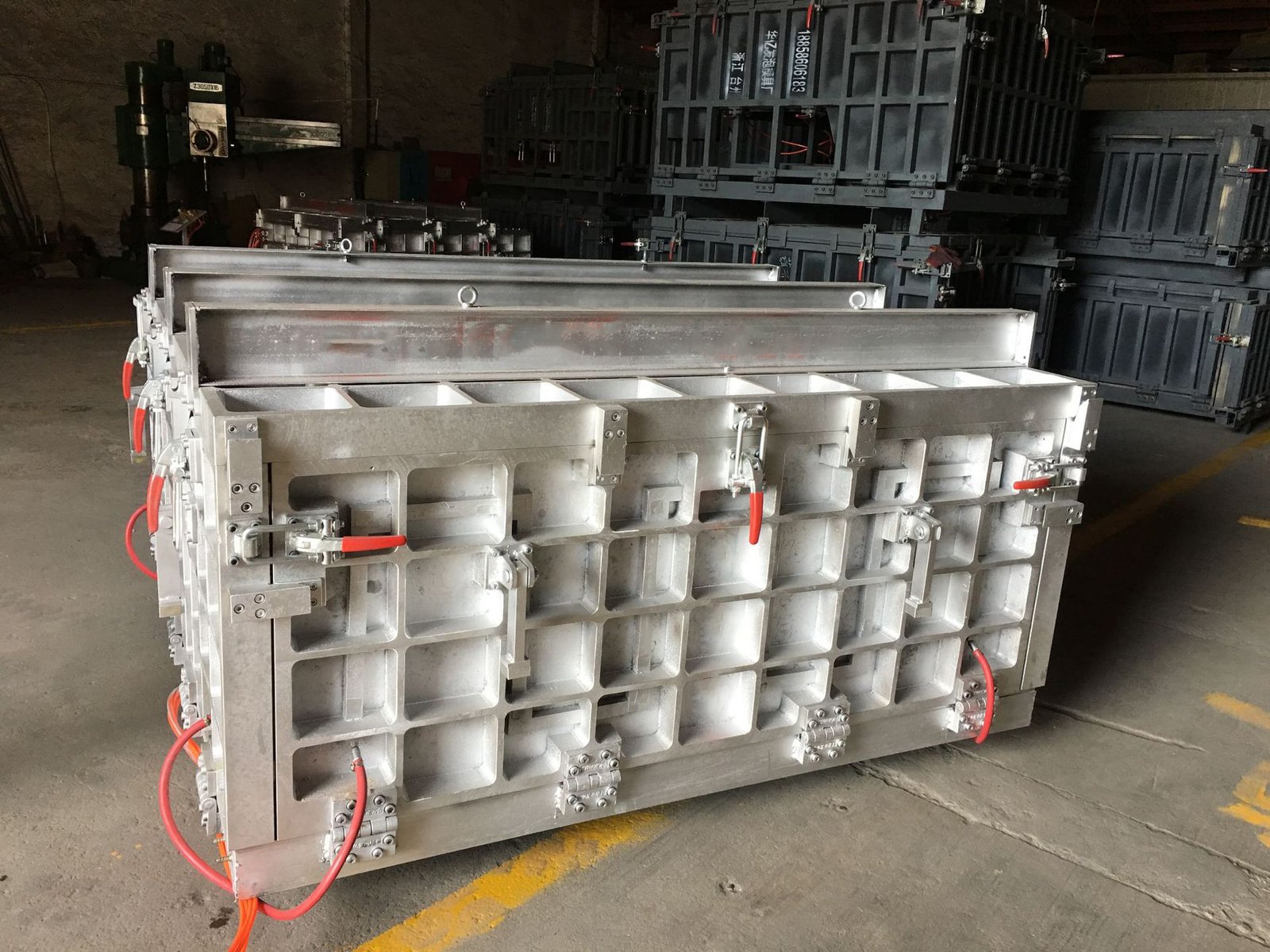
Thermal Conductivity and Thermal Uniformity
Polyurethane(PU)foaming is essentially a precisely controlled exothermic chemical reaction.After isocyanate and polyol are mixed,they rapidly heat up and expand within the mold cavity.In this process,the mold is not merely a container;it acts as a sophisticated thermal buffering system.
1. Ultra-Fast Thermal Response
The thermal conductivity of aluminum is approximately 167 W/(m⋅K),while standard mold steel(such as P20)is only 42 W/(m⋅K).This means aluminum conducts heat four times faster than steel.
- Startup Efficiency:At the beginning of every shift,molds must be preheated from room temperature to the optimal reaction temperature(typically 45∘C).Aluminum molds reach this set point in significantly less time,drastically reducing factory downtime.
- Dynamic Regulation:When the foaming reaction releases massive amounts of heat,causing localized temperature spikes,aluminum molds rapidly conduct that heat away to the cooling channels.This prevents”scorched cores”or coarse cell structures caused by localized overheating.
2. Superior Thermal Uniformity
Freezer cabinets have vast surface areas.If the mold surface temperature is uneven,the PU liquid will instantly increase in viscosity upon contacting cooler zones,obstructing the flow.
The advantage of aluminum lies in its high thermal diffusivity,ensuring that temperature fluctuations across any point of the mold surface are kept within±1∘C.
This extreme consistency ensures a uniform PU foam”skin”thickness,completely eliminating surface defects such as flow marks,orange peel,and localized shrinkage caused by temperature gradients.
Shortening Curing Cycles and Increasing Turnover
In the B2B manufacturing sector,Cycle Time is the lifeline of the business.The output capacity of a freezer production line is often bottlenecked by the longest stage:foam curing.
1. The Perfect Synergy of Cooling and Chemistry
After the PU foam expands,it must cool until it reaches sufficient structural strength for demolding.Because aluminum dissipates heat so rapidly,it carries away the excess heat of the exothermic reaction much earlier than steel,allowing the foam to reach a stable state sooner.
Field measurements on actual production lines show that using precision aluminum molds typically shortens the curing time by 10%to 20%compared to steel molds.
If a freezer’s curing time is reduced from 300 seconds to 250 seconds,the daily output of a single station increases by approximately 16%.
2. Reduced Maintenance Downtime
The superior machinability of aluminum makes routine maintenance—such as cleaning vent plugs or replacing seals—far more efficient.
In high-speed automated production,these incremental time savings accumulate into massive economic gains.
Our molds further reduce material buildup through precision hard-anodizing and modular structural design.
This means your production lines not only benefit from faster maintenance but also significantly extended service intervals. Leveraging Ours superior craftsmanship, we ensure that every critical component retains high strength while offering exceptional flexibility for assembly and disassembly, helping enterprises minimize downtime losses to the absolute limit.
The Systems Engineering Value of Lightweight Design
Freezer molds often weigh several tons.The difference in material density does not just change the mold;it fundamentally alters the mechanical requirements of the entire production line.
1. Reducing Mechanical Load and Energy Consumption
With a density of approximately 2.7 g/cm3,aluminum is only about one-third the weight of steel(7.8 g/cm3).
- Protecting Automated Fixtures:The kinetic energy and inertial loads placed on turnover mechanisms,clamping cylinders,and conveyor motors are significantly lower when driving aluminum molds.
This reduces fatigue wear on mechanical components and extends the maintenance intervals of the entire line.
- Energy Efficiency:Less power is required to drive lightweight molds,aligning with the”Green Energy”standards of modern manufacturing.
2. Enhanced Operational Safety
During mold changes,hoisting,and on-site maintenance,the lighter weight of aluminum molds reduces the risk of workplace accidents,making the environment safer for operators.
Balancing Precision Machining with Longevity
1. Integrated Water Circuits and Complex Structures
Modern freezer molds are far more than hollow cavities;they are honeycombed with complex,temperature-controlled circulation channels.
The machining efficiency of aluminum is several times higher than that of steel.This allows engineers to design more precise and extensive”serpentine”or”conformal”cooling channels.
Even micro-venting structures can be machined into aluminum—tasks that would be prohibitively expensive and time-consuming in high-hardness steel.
2. Surface Treatments:Bridging the Hardness Gap
The traditional view that aluminum molds are less durable than steel is outdated in the context of PU foaming—a low-abrasion process.
- Hard Anodizing:Aluminum surfaces can undergo hard-anodization,significantly increasing surface hardness to withstand tens of thousands of clamping and demolding cycles.
- Non-Stick Coatings:Aluminum provides an excellent substrate for PTFE(Teflon)and other anti-stick coatings.This reduces the reliance on release agents,resulting in a cleaner product finish and longer intervals between cleanings.
Deep Analysis of ROI and Total Cost of Ownership(TCO)
While the initial procurement cost of aluminum is higher,a look at the 10-year operational lifecycle reveals a different story:
Initial Investment(CapEx):Shorter machining hours for aluminum molds often offset a portion of the material price premium.
Operating Expenses(OpEx):Energy Savings:Energy consumption for preheating and temperature control is reduced by approximately 15%.
- Capacity Gains:The profit increase from shortened cycle times is immense,typically covering the mold premium within 6 to 12 months of operation.
- Reduced Defect Costs:Scrap rates caused by thermal inconsistency typically drop from 2%to under 0.5%.
- Residual Value:Aluminum molds retain a high scrap value(often over 60%of the raw material cost),whereas steel molds are essentially treated as scrap iron at the end of their life.
As a leader in polyurethane equipment,we have specialized in aluminum alloy mold technology for over two decades.
We understand that a freezer mold is not just an isolated metal box;it is a multiplier for factory profitability.
Our aluminum alloy mold solutions offer unique advantages:
- FEA Structural Optimization:Ensuring zero deformation of the aluminum mold under high-pressure foaming.
- Patented Precision Venting:Combining aluminum’s machinability to achieve micron-level,flash-free venting.
- System Integration:Our equipment automatically optimizes injection curves based on the thermal response characteristics of the aluminum mold.
In this”Efficiency-First”era,choosing aluminum alloy molds is not just choosing a better material—it is choosing a higher-yield,lower-cost,and more sustainable production paradigm.