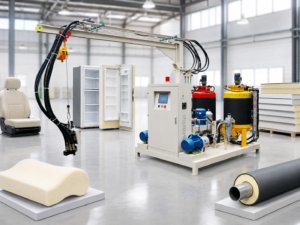
Quick answer. Most PU casting defects trace to three variables: entrained or process-generated gas (bubbles and voids), off-ratio stoichiometry or uneven exotherm (shrinkage and sink marks), and mismatched mold temperature or demold timing (sticking and tearing). Before reworking a formulation, audit vacuum degassing level, polyol moisture content, metering pump repeatability, and mold surface temperature. On hot-cast MDI/TDI elastomer lines, a large share of “bad batch” complaints trace back to machine-side calibration drift rather than a defective resin lot.
This checklist is written for buyers and process engineers running or specifying a PU casting machine, not for resin chemists. Each defect is broken into a symptom, a root cause, an on-floor check, and a fix you can run during the next shift.
Bubbles and Voids: Diagnostic Checklist
Why the Same Resin Lot Passes on One Machine and Fails on Another
A polyol/isocyanate system that meets its technical data sheet in the lab can still cast defective parts on the shop floor. The variables that separate a Class-A part from a scrapped one are almost all machine-controlled: pour rate, vacuum hold time, component temperature, and A:B ratio accuracy.
That is why the first move on a defect is not to call the resin supplier — it is to pull the machine’s calibration log for the batch in question. See the full process breakdown in our polyurethane casting process guide for degassing, metering, and cure-stage detail.
Bubbles fall into three visually distinct categories, and each points to a different failure point in the process rather than a single generic “air in the mix” cause.
| Defect | Visual Symptom | Most Likely Root Cause | On-Floor Check | Corrective Action |
|---|---|---|---|---|
| Surface pinholes | Fine bubbles concentrated at the mold-facing surface | Entrained air from high-shear pre-mix or a turbulent pour stream | Watch the pour stream for visible froth or foam | Pour in a thin, steady stream against the mold wall; slow the dispense rate |
| Internal voids | Large gas pockets found when parts are cut or sectioned | Moisture in the polyol reacting with isocyanate (CO2 release), or trapped air at the flow front | Karl Fischer moisture test on the polyol (ASTM E203); check vent placement | Dry polyol under vacuum to below 0.05% water; add or relocate vents at the highest cavity points |
| Cloudy/micro-foam cross-section | Fine dispersed bubbles giving a milky cut face | Under-degassed resin or insufficient vacuum hold time | Log the vacuum gauge reading at the end of the hold cycle, not at pull-down start | Hold at -0.090 to -0.095 MPa for 3-5 minutes, scaled to batch volume |
| Sink marks | Localized surface depression over thick sections | Uneven exotherm across thick-to-thin wall transitions | Measure wall thickness variance against the mold drawing | Add ribbing to reduce max section thickness; apply a graded post-cure ramp |
| Bulk shrinkage | Finished part measures 1-3% under the cavity dimension | Off-ratio A:B mix or an incomplete cure | Verify metering pump output ratio by weight, not by pump setting | Recalibrate pumps to rated repeatability; extend the post-cure schedule |
| Sticking or tearing on demold | Resin adheres to the mold; surface tears on release | Release agent depletion, mold temperature outside the qualified window, or premature demold | Check mold surface temperature with an IR thermometer; compare elapsed time to gel time | Reapply release agent; hold mold temperature in range; delay demold past the green-strength threshold |
Shrinkage and Sink Marks: Stoichiometry, Wall Thickness, and Post-Cure
Cast PU elastomers shrink for two independent reasons that get treated as one problem: chemical shrinkage from an off-ratio A:B mix, and physical shrinkage from uneven cooling across variable wall sections.
A metering pump that drifts outside ±1% volumetric repeatability shifts the effective A:B ratio, which under-cures or over-cures the matrix and shows up as tackiness, brittleness, or a part that measures under-dimension after 24 hours. Check pump output by weighing 10 consecutive shots into a tared cup and calculating the run-to-run variance, rather than trusting the dial setting.
Wall sections thicker than roughly 25 mm build up enough exotherm to exceed 150°C at the core, which causes internal stress and a visible sink mark at the surface directly above it. A post-cure step — commonly 12 to 24 hours at 100-110°C for hot-cast systems — completes cross-linking and relieves that stress; skipping it is the single most common cause of parts that look fine at demold and shrink over the next day.
Poor Demolding: Sticking, Tearing, and Delamination
Demolding problems are a timing and surface-condition issue, not a formulation issue in most cases. Three variables interact: mold surface temperature, release agent condition, and elapsed time relative to gel time.
Mold temperature outside the system’s qualified range (commonly 70-120°C for hot-cast MDI/TDI elastomers, per the resin data sheet) either leaves the surface under-cured and tacky or scorches it. Demolding before the part reaches adequate green strength tears the surface even when the mold and release agent are correct — the fix is almost always to wait longer, not to change chemistry.
Buyer’s Machine-Side Spec Checklist
Before authorizing a formulation change, verify these machine parameters against the casting machine’s rated specification sheet. These are the values a buyer should request in writing from the machine builder before purchase, and re-verify during factory acceptance testing.
| Parameter | Typical Target | Why It Matters | How to Verify |
|---|---|---|---|
| Metering pump repeatability | ±1% by volume, shot-to-shot | Off-ratio mix is the leading driver of shrinkage and incomplete cure | Weigh 10 consecutive shots, calculate %RSD |
| Injection/dispense pressure | 0.01-0.1 MPa, component-dependent | Too low causes streaking from poor mixing; too high entrains air | Compare gauge log against the machine’s rated range |
| Vacuum degassing level | -0.090 to -0.095 MPa | Residual dissolved air becomes visible bubbles after cure | Read the vacuum gauge at end-of-hold, not at pull-down start |
| Component temperature control | ±2°C of set point | Viscosity and gel time both shift with small temperature drift | Cross-check heater-band thermocouple against an independent probe monthly |
| Polyol moisture content | Below 0.05% (500 ppm) water | Above this threshold, the CO2 side-reaction generates internal voids | Karl Fischer titration (ASTM E203) on each incoming drum lot |
Escalation Path and Floor Safety
Machine Builder vs. Resin Supplier
Escalate to the machine builder when the defect is reproducible across different resin lots but tied to a specific pump, mold station, or shift. Escalate to the resin supplier when a single incoming batch fails a moisture or NCO-content check that prior batches passed.
Buying direct from the equipment manufacturer shortens this loop: a factory-direct casting machine builder can run a factory acceptance test with the buyer’s own resin system before shipment, and supply calibration certificates for the metering pumps rather than routing every adjustment through a distributor. Custom mold-temperature ranges and A:B ratio configurations (including non-1:1 systems) are a specification decision made before the machine is built, not a field retrofit.
Isocyanate Handling on the Casting Floor
MDI and TDI vapors and aerosols are respiratory sensitizers, and dermal contact is a documented route to later respiratory sensitization. The OSHA isocyanates safety and health topics page outlines exposure controls for mixing and pouring stations, and the OSHA isocyanate hazard recognition page details why skin contact, as much as inhalation, drives long-term sensitization risk.
A casting cell with a properly sealed mix head and local exhaust at the pour station reduces both the defect rate from contamination and the exposure risk to operators — the two problems share the same root fix.
FAQ
Q: What vacuum level prevents bubbles in PU casting?
Hold the resin at -0.090 to -0.095 MPa for 3-5 minutes before pouring, scaling hold time up for larger batch volumes and higher-viscosity systems.
Q: Why does my cast PU part shrink after it looked fine at demold?
Delayed shrinkage after demold is almost always an incomplete post-cure. If the part was not held at 100-110°C for 12-24 hours after casting, cross-linking continues at room temperature and the part shrinks over the following day.
Q: How do I know if a casting defect is the machine or the resin?
Run the same resin lot through a different pump or mold station. If the defect follows the machine station, it is calibration; if it follows the resin batch across multiple stations, test that batch’s moisture content and NCO value before contacting the supplier.
Q: What moisture content is safe for polyol used in casting?
Keep water content below 0.05% (500 ppm), verified by Karl Fischer titration per ASTM E203. Above that, the moisture-isocyanate side reaction releases CO2 and produces internal voids.
Q: Can one casting machine run both MDI and TDI systems?
Yes, if the machine’s metering pumps, seals, and heating circuits are specified for both component viscosity ranges at purchase. Retrofitting a machine built for one system to run the other usually requires new pump heads and a revised A:B ratio setting rather than a software change.