High-pressure polyurethane injection machines are widely used in industrial production where accurate metering, repeatable mixing, short cycle times, and automated operation are important.
However, different products require very different machine configurations. An automotive seat cushion, refrigerator cabinet, cold-room panel, memory foam pillow, and insulated pipe may all use polyurethane, but their shot weight, material system, mold structure, pouring time, and production capacity are not the same.
For this reason, selecting a high-pressure polyurethane injection machine should start with the finished product rather than with a machine model.
At Yongjia, high-pressure PU foaming systems can be configured according to product weight, required output, material system, number of components, molds, and automation level. Depending on the project, the machine can also be integrated with robots, conveyors, rotary mold lines, fixtures, and other polyurethane production equipment.
What Is a High-Pressure Polyurethane Injection Machine?
A high-pressure PU machine meters polyurethane components, usually polyol and isocyanate, and sends them to a high-pressure mixing head.
Inside the mixing chamber, the components collide at high velocity and mix immediately before being discharged into a mold or cavity.
A typical high-pressure system may include:
- Polyol and isocyanate tanks
- Metering pumps
- Material circulation
- Independent temperature control
- High-pressure mixing head
- PLC and HMI
- Shot-time control
- Pressure monitoring
- Recipe storage
Depending on the application, additional options may include multi-component dosing, robot integration, multiple mixing heads, automatic mold identification, and explosion-protected configurations.
High-pressure systems are especially suitable for factories that require:
- Frequent repetitive shots
- Consistent mixing ratios
- Continuous production
- Multi-mold production lines
- Automated pouring
- Robot integration
- Multiple production recipes
Top 5 Applications at a Glance
| Application | Typical PU System | Typical Products | Main Machine Requirement |
| Automotive seating | Flexible / semi-rigid PU | Cushions, backrests, headrests | Fast repetitive shots and automation |
| Refrigerator insulation | Rigid PU | Cabinets, doors, freezers | Stable closed-cavity filling |
| Sandwich panels | PUR / PIR | Cold-room, roof and wall panels | Controlled continuous output |
| Pillows and furniture | Flexible / memory foam | Pillows, cushions, furniture parts | Repeatable shot weight and mold-line integration |
| Technical insulation | Rigid PU | Pipes, tanks, boilers, water heaters | Large-shot cavity filling |
Automotive Seat and Interior Foam Production
Automotive seat manufacturing is one of the most established applications for high-pressure polyurethane foaming equipment.
Typical molded PU products include:
- Seat cushions
- Backrests
- Headrests
- Armrests
- Side supports
- Interior padded components
Automotive production normally requires large quantities of parts with controlled weight, density, hardness, dimensions, and surface quality.
A small process variation may not be serious in prototype production, but when the same part is produced thousands of times, unstable shot weight or mixing can increase scrap significantly.
Why High Pressure Works Well for Automotive Production
Automotive foam production often uses multiple molds arranged on:
- Carousel lines
- Rotary systems
- Floor conveyors
- Oval conveyors
- Automatic mold carriers
While one mold is curing, another mold reaches the pouring station.
The machine therefore needs to deliver repeated shots quickly and consistently.
A typical process may be:
Mold preparation → Insert loading → PU pouring → Mold closing → Curing → Mold opening → Demolding
For high-volume production, the PU machine can be connected to a robot or automatic positioning system.
This allows the mixing head to repeat the same:
- Pouring position
- Movement speed
- Start and stop point
- Linear path
- Circular path
- Multi-point path
The value of robotic pouring is not only labor reduction. It also makes the process less dependent on individual operator movement.
Different Seat Parts Need Different Settings
A seat cushion may require a relatively large foam shot, while a headrest may require a much smaller one.
This means machine selection should consider both:
Maximum output and minimum controllable output.
For factories producing several seat models on one line, recipe management is also important.
Different molds may require different:
- Shot weights
- Injection times
- Material settings
- Robot programs
A PLC-controlled system can store these recipes and reduce manual adjustment during product changeovers.
Recommended Configuration
For automotive seating, a high-pressure machine may include:
- High-pressure impingement mixing
- Accurate A/B metering
- Independent temperature control
- PLC recipe management
- Automatic shot control
- Robot interface
- Conveyor communication
- Optional multi-component configuration
Before selecting a machine, manufacturers should provide the seat foam weight, pouring time, required hourly output, number of molds, and polyurethane formulation.
Refrigerator, Freezer and Cold-Chain Insulation
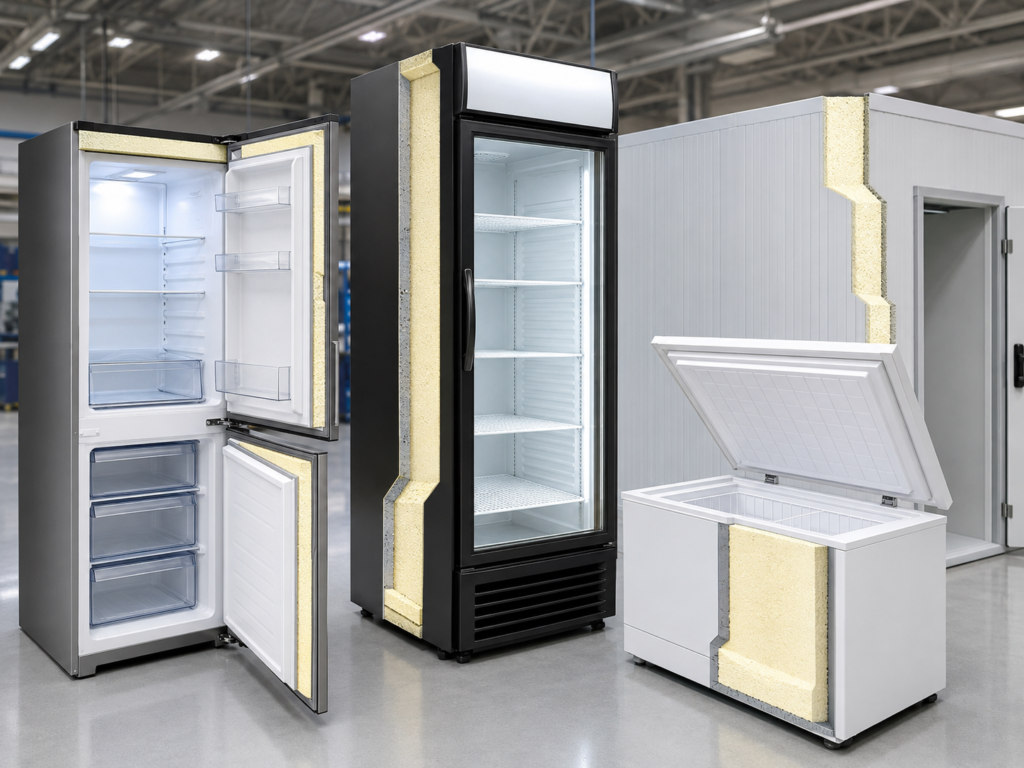
Rigid polyurethane foam is widely used as thermal insulation in refrigerators, freezers, commercial refrigeration equipment, and other cold-chain products.
Typical applications include:
- Refrigerator cabinets
- Refrigerator doors
- Chest freezers
- Display cabinets
- Beverage coolers
- Commercial refrigeration
- Cold-chain equipment
In these applications, polyurethane is usually injected into a closed cavity between an inner liner and an outer shell.
The foam expands inside the cavity and forms the insulation layer.
Why Stable Injection Is Important
The foam must travel through a narrow internal space while reacting and expanding.
Poor process control can lead to:
- Incomplete filling
- Voids
- Uneven density
- Excessive foam consumption
- Cabinet deformation
- Inconsistent insulation
The correct solution is not simply to increase the shot weight.
The PU machine, raw material system, cabinet design, fixture, venting, temperature, and injection position must work together.
A typical cabinet process may include:
- Cabinet preparation
- Inner liner positioning
- Fixture loading
- Fixture closing
- PU injection
- Foam expansion and curing
- Fixture opening
- Cabinet removal
Large factories may operate several fixtures or multiple cabinet and door models.
This makes recipe control especially useful.
Cyclopentane Applications
Some refrigerator rigid-foam systems use cyclopentane.
When cyclopentane is involved, the project requires additional safety considerations.
Depending on the production environment, this may include:
- Explosion-protected electrical components
- Gas detection
- Ventilation
- Grounding
- Safety interlocks
- Controlled material storage
The high-pressure machine should therefore be designed for the actual raw material system rather than treated as a standard foaming machine.
Recommended Configuration
For refrigerator production, the machine may include:
- Rigid PU high-pressure metering
- Automatic shot control
- PLC recipe storage
- Independent temperature control
- Cabinet and door fixture integration
- Multiple mixing-head options
- Cyclopentane-compatible configuration when required
Manufacturers should provide cabinet size, foam weight, pouring time, production capacity, blowing-agent system, and number of fixtures before machine selection.
Sandwich Panels and Building Insulation
High-pressure polyurethane equipment is also used in sandwich-panel production.
Typical products include:
- Cold-room panels
- Cold-storage panels
- Roof panels
- Wall panels
- Insulated doors
- Clean-room panels
The insulation core may use rigid PUR or PIR systems.
Production can be either continuous or discontinuous.
Continuous Production
A continuous panel line may include:
Coil feeding → Profiling → PU distribution → Curing → Cutting → Stacking
The high-pressure machine continuously supplies polyurethane while the panel moves through the production line.
Several parameters must remain synchronized:
- Panel width
- Panel thickness
- Line speed
- PU output
- Foam density
- Reaction time
If line speed changes but chemical output does not, the foam quantity per square meter changes.
For this reason, the metering machine needs to work as part of the complete production system.
Discontinuous Production
Discontinuous production may be more suitable for:
- Smaller output
- Customized panel sizes
- Special doors
- Frequent product changes
- Non-standard products
In this process, polyurethane is injected or poured into individual panel assemblies before curing.
A discontinuous system may require less total output but greater flexibility.
Recommended Configuration
Machine requirements depend on:
- PUR or PIR formulation
- Panel size
- Core thickness
- Required density
- Production speed
- Continuous or discontinuous process
A suitable system may include:
- Stable high-output metering
- Accurate ratio control
- Continuous material circulation
- Multiple-component capability
- Automatic output adjustment
- Multiple or moving pouring heads
In panel production, the high-pressure machine should be considered the metering and mixing core of the PU process rather than the entire panel production line.
Memory Foam Pillows, Furniture and Molded Comfort Products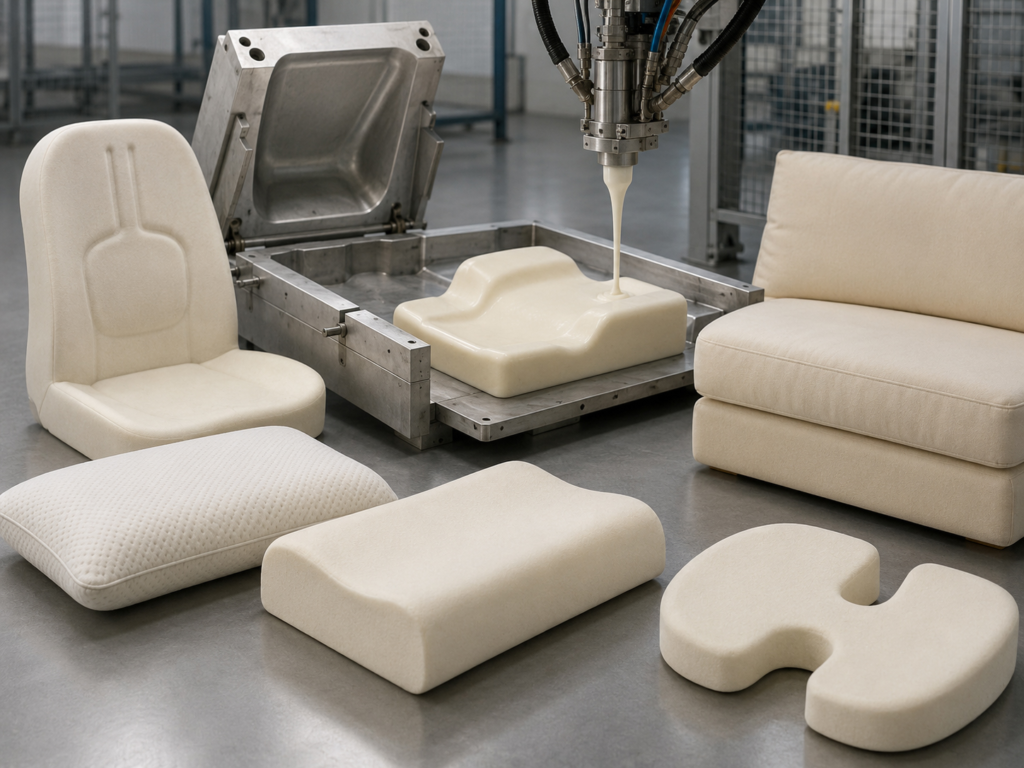
Flexible polyurethane foam is widely used in molded comfort products such as:
- Memory foam pillows
- Contour pillows
- Furniture cushions
- Sofa components
- Office-chair foam
- Medical support cushions
Unlike slabstock foam, molded foam is poured directly into a shaped mold.
This allows manufacturers to produce complex three-dimensional designs with ergonomic contours, ventilation channels, and different thickness zones.
Typical Pillow Production Process
A molded pillow line may include:
Raw materials → PU injection → Mold curing → Demolding → Cell opening → Hole punching → Inspection → Packaging
Molds may be arranged on:
- Rotary lines
- Curved production systems
- Floor rails
- Conveyor lines
Smaller factories may use manual pouring, while higher-volume factories can adopt semi-automatic or robotic systems.
When High Pressure Becomes More Attractive
Low-pressure equipment can still be suitable for small batches and customized production.
High-pressure systems become more attractive when the factory needs:
- Higher daily capacity
- Frequent repetitive shots
- More stable shot weight
- Multiple molds
- Automatic mold movement
- Robot integration
- Continuous production
High Pressure vs. Low Pressure for Molded Foam
| Production Situation | Suggested Direction |
| Prototype or small batch | Low pressure |
| Small/medium mixed production | Low or high pressure |
| High-volume molded pillow production | High pressure |
| Rotary multi-mold line | High pressure |
| Robotic pouring | High pressure |
| Multi-shift continuous production | High pressure |
Robot Integration
A robot can move the mixing head using different pouring paths, including:
- Fixed-point pouring
- Linear pouring
- Circular pouring
- Multi-point pouring
The shortest robot path is not always the best foam-filling path.
The correct movement depends on the pillow shape, material viscosity, cream time, mold temperature, and foam-flow behavior.
Recommended Configuration
A high-pressure machine for molded pillows or furniture foam may include:
- Accurate two-component metering
- Automatic shot-time control
- Recipe storage
- Independent temperature control
- Wide working output range
- Robot interface
- Conveyor communication
For a new pillow factory, the required machine output should be calculated from foam weight per product and pouring time, not simply from the number of pillows per hour.
Pipe, Water Heater and Technical Insulation
Technical insulation is another important application for high-pressure rigid PU systems.
Typical products include:
- Pre-insulated pipes
- District-heating pipes
- Water heaters
- Boilers
- Hot-water tanks
- Storage vessels
- HVAC components
In many of these applications, polyurethane is injected into an enclosed cavity.
Pre-Insulated Pipes
A typical pipe structure consists of:
- Inner service pipe
- Rigid PU insulation
- Outer casing
The polyurethane mixture fills the space between the inner pipe and outer casing.
Important parameters include:
- Pipe diameter
- Pipe length
- Insulation thickness
- Shot weight
- Material flow distance
- Injection position
Long pipes can be challenging because the foam must travel a considerable distance before gelation.
This means machine output and pouring position must be matched to the product.
Water Heaters and Tanks
Water heaters typically use PU foam between the inner tank and outer shell.
The process is similar to refrigerator insulation, but the cavity geometry is different.
Manufacturers must consider:
- Injection position
- Shot quantity
- Shot speed
- Venting
- Fixture design
- Cure time
Large industrial insulation products may require much heavier individual shots than pillows or small automotive components.
Recommended Configuration
A high-pressure system may include:
- Rigid PU metering
- Larger output range
- Automatic shot control
- Long heated hoses
- Multiple pouring stations
- Moving mixing head
- Fixture interlock
- Recipe management
Machine selection should be based on cavity volume, required PU weight, pouring time, hose distance, and production capacity.
How We Configure a High-Pressure PU Machine
Although all five industries use high-pressure polyurethane processing, they do not need identical equipment.
At Yongjia, machine selection starts with the actual production requirement.
| Application | Main Configuration Focus |
| Automotive seat foam | Repetitive shots, recipes, robot integration |
| Refrigerator/freezer | Rigid foam filling, fixtures, cyclopentane option |
| Sandwich panels | Stable output and distribution |
| Pillow/furniture foam | Multi-mold production and robot integration |
| Pipe/tank insulation | Larger shots and controlled cavity filling |
Depending on the project, a Yongjia high-pressure PU system can be configured with:
- High-pressure impingement mixing
- Accurate component metering
- Self-cleaning mixing head
- Independent temperature control
- PLC and HMI
- Recipe storage
- Multi-component options
- Robot integration
- Conveyor communication
- Customized output range
The purpose is not to supply the largest machine available, but to match the machine to the product.
What Machine Output Do You Need?
A preliminary output requirement can be calculated using:
Required mixed output = PU weight per shot ÷ pouring time
For example, if an automotive seat cushion requires:
1,500 g of polyurethane
and the pouring time is:
5 seconds
then:
1,500 ÷ 5 = 300 g/s
The preliminary mixed output requirement is approximately 300 g/s.
However, this is only the first calculation.
Final machine selection must also consider:
- Polyol/isocyanate ratio
- Minimum output
- Maximum output
- Material viscosity
- Mixing-head size
- Hose length
- Injection frequency
- Future product range
A machine should cover the actual working range rather than simply provide the highest possible maximum output.
What Information Should You Prepare Before Requesting a Machine?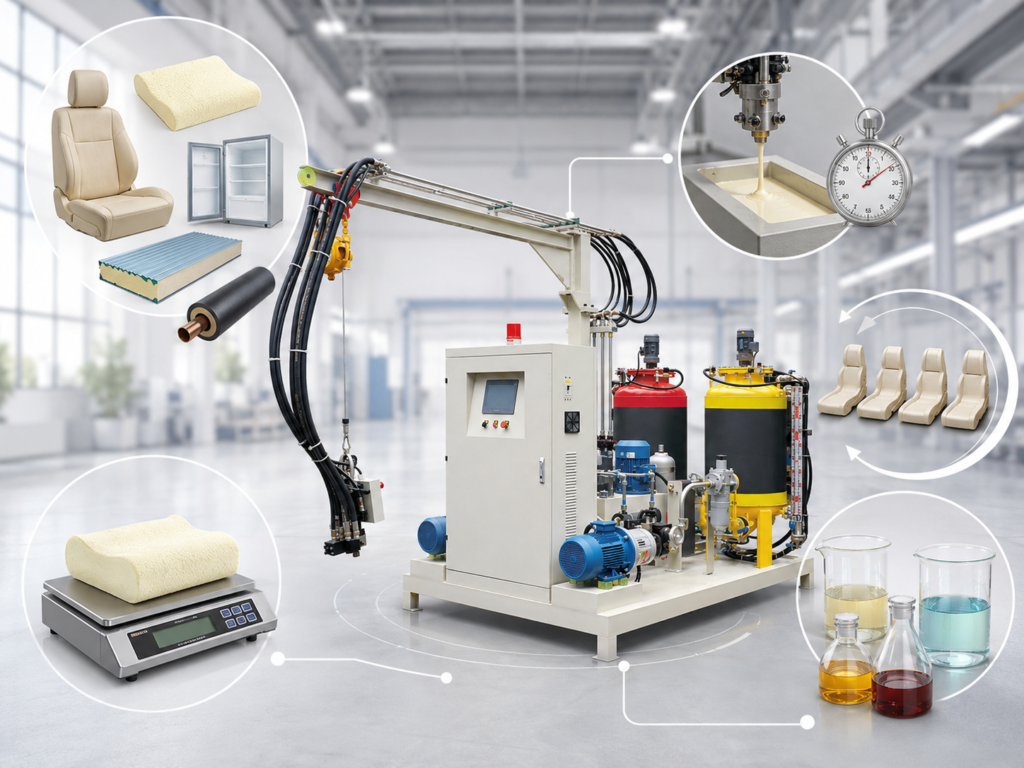
Before requesting a high-pressure PU machine quotation, prepare the following information:
Product type
Automotive seat, pillow, refrigerator, panel, pipe, or another molded PU product.
PU weight per shot
Approximate polyurethane weight required for one product.
Pouring time
How many seconds are available for each injection.
Required production capacity
For example, pieces per hour or pieces per day.
PU material system
Flexible foam, memory foam, rigid foam, integral skin foam, or another formulation.
It is also helpful to provide:
- Product drawings
- Mold quantity
- Component ratio
- Number of components
- Required automation level
With this information, the machine output and configuration can be calculated much more accurately.
Common Machine Selection Mistakes
Selecting by Maximum Output Only
A larger machine is not automatically better.
If one factory produces large seat cushions and small headrests, the machine must handle both products reliably.
Ignoring Mold Design
Foam flow depends strongly on mold geometry, venting, inserts, and pouring position.
Machine and mold should therefore be evaluated together.
Ignoring the Complete Production Cycle
A faster injection machine does not automatically increase factory output.
For molded products, capacity depends on:
Preparation + pouring + curing + demolding + downstream processing
If curing is the bottleneck, increasing injection output alone will not solve the problem.
Automating an Unstable Process
Robot pouring should reproduce a proven process.
Shot weight, temperature, pouring position, and foam behavior should first be stabilized before automation is introduced.
Choosing the Right High-Pressure PU Machine in 2026
High-pressure polyurethane injection machines are increasingly integrated into complete production systems rather than operating as independent equipment.
Automotive factories connect them with robots and mold conveyors.
Refrigerator manufacturers connect them with cabinet and door fixtures.
Panel producers synchronize them with production-line speed.
Pillow factories integrate them with multi-mold lines and robotic pouring.
Technical-insulation manufacturers configure them around large cavities and long pouring distances.
The correct machine therefore depends on the complete process.
For manufacturers planning a new PU project, the most useful starting information is:
Product + PU weight + pouring time + required capacity + material system
From these parameters, the required output range, mixing-head configuration, automation level, and production-line layout can be determined.
Get Your High-Pressure PU Machine Recommendation
If you manufacture automotive seats, refrigerator cabinets, sandwich panels, memory foam pillows, furniture foam, pipes, tanks, or other polyurethane products, send us your product information together with:
- PU weight per shot
- Pouring time
- Required production capacity
- PU material system
Our engineers can then recommend the suitable high-pressure polyurethane injection machine output and configuration for your production project.